

 800-811-7514
What Is the Best Mattress for Lower Back Pain and Side Sleepers?
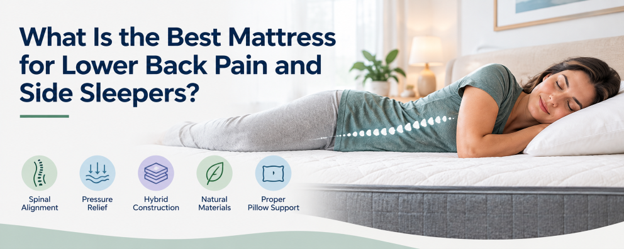
If you sleep on your side and deal with lower back pain, you've probably noticed something frustrating: most mattress advice is written for one problem or the other, never both at once. Side-sleeper guides talk about shoulder and hip pressure.
Back-pain guides talk about spinal support. But when you're trying to find the best mattress for low back pain, and you're a committed side sleeper, you need something that solves both at the same time, and that's a narrower, trickier search than either one alone.
Why Side Sleeping Can Affect Spinal Alignment

When you sleep on your side, your spine isn't lying flat; it has to stay level from your neck down to your hips despite your shoulder and hip being the widest points of contact with the mattress. If the surface doesn't let those areas sink in enough, your spine bends upward in the middle, straining your lower back all night.
If it lets them sink in too much, the opposite happens: your midsection drops, and your lower back curves the wrong way. Either version tends to show up as morning stiffness or a dull ache that eases once you're up and moving.
This is really the core challenge behind finding the best mattress for low back pain as a side sleeper: it's not just about softness or firmness in the abstract; it's about whether the surface keeps your spine level in the one position you actually sleep in.
Why Your Hips and Shoulders Matter
Your hips and shoulders carry most of your body weight when you're on your side, so they need a mattress that contours around them rather than resisting them. A surface that's too firm creates pressure points at these joints; you'll feel it as numbness in the arm you're lying on, or a hip that aches by morning.
But a mattress soft enough to relieve that pressure still has to catch your waist and lower back so your spine doesn't sag out of line. That balance give at the joints, support at the waist is the whole ballgame for lower back comfort on your side. When deciding what mattress is best for your back, consider how well it cushions your shoulders and hips while keeping your waist and lower back properly supported.
How Mattress Firmness Changes the Experience
Side sleepers generally do best somewhere between medium-soft and medium-firm, which is softer than what's usually recommended for back or stomach sleepers. This is one reason a generic recommendation falls short: the best mattress for lower back pain for a back sleeper and the best one for a side sleeper aren't the same product, or even the same firmness level.

If you're side sleeping with lower back pain specifically, look for a mattress that leans toward the contouring end of medium, not the firm end. Firm surfaces tend to help general back support but often work against side sleepers by not letting the hips and shoulders sink in enough.
Pressure Relief vs. Support
It's worth separating these two ideas clearly, because they pull in opposite directions:
● Pressure relief is about the top layer softening enough at your shoulders and hips that blood flow isn't restricted, and you're not waking up to reposition.
● Support is about the base layer keeping your spine level, not letting your midsection sink lower than it should.
A mattress that only does one of these will leave you with either pressure pain or back pain, sometimes both. This is exactly why hybrid constructions tend to outperform single-material mattresses for this specific combination of needs: a responsive top layer handles pressure relief, while a coil support core handles alignment.
What to Look for in a Hybrid
If you're shopping for the best mattress for low back pain as a side sleeper, a well-built hybrid is usually the strongest starting point: something with a contouring top layer (latex or foam) over individually wrapped coils that respond independently to your hips and shoulders rather than one solid slab underneath everything.
This is the exact approach Sweet Zzz takes with the Honey Hybrid: organic Dunlop latex layered over individually wrapped American steel coils, designed with chiropractors specifically for spinal alignment and pressure relief, not just general comfort.

Because it's offered in medium-soft, medium-firm, firm, and extra-firm builds, side sleepers with lower back pain can lean toward the softer end of that range instead of settling for a one-size firmness.
Pillow Placement and Mattress Interaction
Even the best mattress for low back pain can't fully do its job if your pillow setup is fighting it. Side sleepers typically need a pillow thick enough to keep the neck level with the spine; too thin and the neck tilts down, too thick and it tilts up, both of which pull the rest of the spine out of alignment along with it.
Many side sleepers with lower back pain also benefit from a pillow between the knees, which keeps the hips stacked and takes pressure off the lower back and hip joint overnight.

Sweet Zzz built the Honey Hybrid around this exact combination of needs: organic materials, chiropractor input, and multiple firmness options so side sleepers dealing with lower back pain aren't stuck choosing between pressure relief and support. It's possible to have both.
For side sleepers dealing with lower back pain, the right mattress needs to balance pressure relief and spinal support. A medium-soft to medium-firm hybrid can provide enough contouring for the shoulders and hips while maintaining support through the waist and lower back. Your pillow setup matters, too, especially keeping your neck and hips properly aligned throughout the night.
If you're considering the best mattress for low back pain, focus less on choosing the firmest mattress and more on finding a surface that supports your sleeping position. The Sweet Zzz Honey Hybrid offers multiple firmness options, organic Dunlop latex, and individually wrapped coils, giving side sleepers options for finding a balance between cushioning and support.