

 800-811-7514
What Mattress Firmness Is Best for Back Pain? A Simple Guide to Finding the Right Feel
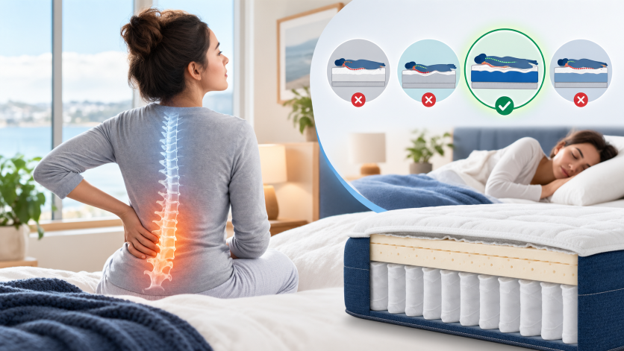
If your back hurts, the advice seems simple: buy a firm mattress. But then you lie down on one and wonder why your hips and shoulders feel like they're being pressed into the bed.
If that's happened to you, you're not imagining it. Firmness and back support aren't the same thing, and getting them confused is one of the easiest ways to end up with a mattress that makes your pain worse, not better.
Finding the best mattress for back pain starts with understanding how firmness, support, and pressure relief work together.
Does Firmer Really Mean Better for Your Back?
Not necessarily. A mattress that's too firm doesn't compress at all under your hips and shoulders, so your spine is forced into an unnatural, flattened position rather than its natural curve. A mattress that's too soft does the opposite it lets those heavier parts of your body sink too far, pulling your spine out of alignment the other way.
What actually matters for back pain is support with contouring a surface firm enough to keep your hips from sinking below your shoulders, but soft enough to relieve pressure at the points where your body presses hardest into the bed. When choosing what mattress is best for your back, focus on how well it balances support with pressure relief rather than simply choosing the firmest option.
What Does Medium-Firm Actually Feel Like?
"Medium-firm" gets thrown around a lot, but in practice it means a mattress that offers just enough give to cradle your shoulders and hips, while still pushing back enough to keep your midsection from dipping.
Sink in too far, and you lose alignment; stay too rigid, and you create pressure points. Medium-firm is the middle ground where most people and most research on sleep surfaces and spinal health land as the sweet spot for combination and back sleepers dealing with pain.
How Firmness Affects Spinal Alignment
Your spine has a natural S-curve, and a mattress is doing its job when it supports that curve rather than fighting it. Picture lying on your side: a good mattress lets your shoulder and hip sink in slightly while keeping your waist supported, so your spine stays roughly level from neck to tailbone. Too firm, and your shoulder can't sink at all, forcing your spine into a bend. Too soft, and your hip drops too low, causing the opposite bend.

This is exactly the kind of support Sweet Zzz built the Honey Hybrid around: individually wrapped coils paired with organic latex layers designed to let the coils respond to your body's pressure points while keeping your midsection properly supported.
If you're wondering what mattress is best for your back, look for a construction that combines responsive cushioning with enough underlying support to maintain spinal alignment.
Firmness for Back vs. Side vs. Stomach Sleepers
● Back sleepers generally do best on medium-firm surfaces that support the lower back without letting the hips sink too far.
● Side sleepers usually need a bit more give at the shoulders and hips, medium to medium-soft to avoid pressure buildup on those joints.
● Stomach sleepers tend to need a firmer surface overall, since a soft one can let the midsection sink and strain the lower back.
This is one reason a single "best" firmness doesn't exist; it's why mattresses that offer multiple firmness options, as the Honey Hybrid's medium-soft, medium-firm, firm, and extra-firm builds, tend to serve a wider range of sleepers than a one-firmness-fits-all product.
How Body Weight Changes the Way a Mattress Feels
Firmness isn't fixed; it's relative to your weight. A mattress that feels medium-firm to a 130-pound sleeper might feel closer to soft under someone who weighs 220 pounds, because heavier bodies compress the top layers further.
If you're on the heavier side, you may need to size up in firmness from what you'd otherwise choose; lighter sleepers often need to size down to get real pressure relief.

How to Choose the Right Firmness for Back Pain

- Identify your primary sleep position (most people are a mix go with what you fall asleep in).
- Factor in your body weight relative to the mattress's stated firmness.
- Look for a mattress built with layered, responsive materials rather than a single slab of firm foam this is what actually creates the "support plus contouring" combination that helps with pain.
- If possible, choose a brand offering more than one firmness option, since even people with similar pain can need different feels.
- Give it time spinal alignment on a new surface can take a couple of weeks to feel fully settled.
Where the Honey Hybrid Fits
The Honey Hybrid was built specifically around this support-plus-contouring idea. It layers organic Dunlop latex over individually wrapped American steel coils, with organic wool and cotton in the cover materials chosen with chiropractors during the design process rather than guessed at afterward.
Because it comes in medium-soft, medium-firm, firm, and extra-firm builds, it's one of the few mattresses that lets back sleepers, side sleepers, and heavier or lighter sleepers each land on the firmness that actually fits them, instead of settling for a generic "medium."

It's also built without the polyurethane foams and chemical flame retardants common in most mattresses no fiberglass, no chemical sprays; using certified organic cotton, natural latex, and New Zealand wool instead. For anyone dealing with back pain, that combination of doctor-informed support and cleaner materials is worth factoring in alongside firmness itself.
The best mattress for back pain isn't simply the firmest option. What matters is finding the right balance of support and pressure relief for your sleep position, body weight, and personal comfort. Medium-firm can be a useful starting point for many back sleepers, while side and stomach sleepers may need a different level of give or support.
When choosing a mattress, look beyond the firmness label and consider how the layers work together to support your spine while cushioning pressure points. The Sweet Zzz Honey Hybrid offers medium-soft, medium-firm, firm, and extra-firm options, giving sleepers more flexibility to find a feel that matches their individual needs.
If you're comparing options for the best mattress for back pain, consider how each firmness level feels under your body rather than relying on the firmness label alone.